A commonly unknown chapter of the final phase of the Second World War in the Insubrica region is related to the bombardment of two hamlets and the sinking of three ships in two days. And all of this happened precisely on Monday, 25 September 1944, and the next day on Tuesday, 26 September, between Luino and Baveno-Intra in Italy.
In order to understand the dynamics of the events efficiently, it is necessary to see the bigger picture of what was happening:
At the beginning of September 1944, the Allied military forces advanced rapidly up the Italian peninsula. The North of Italy (the area adjacent to Lake Maggiore) was occupied by the German military forces and was politically administered by the Neo-Fascist government called “la Repubblica Sociale Italiana” (RSI). Increased aerial activity was observed over Lake Maggiore, precisely in the regions of Ossola and Mottarone. This activity was mostly associated with Allied transport aeroplanes that were used for intelligence missions in order to help the guerrilla movements fighting against Germans and Fascists.

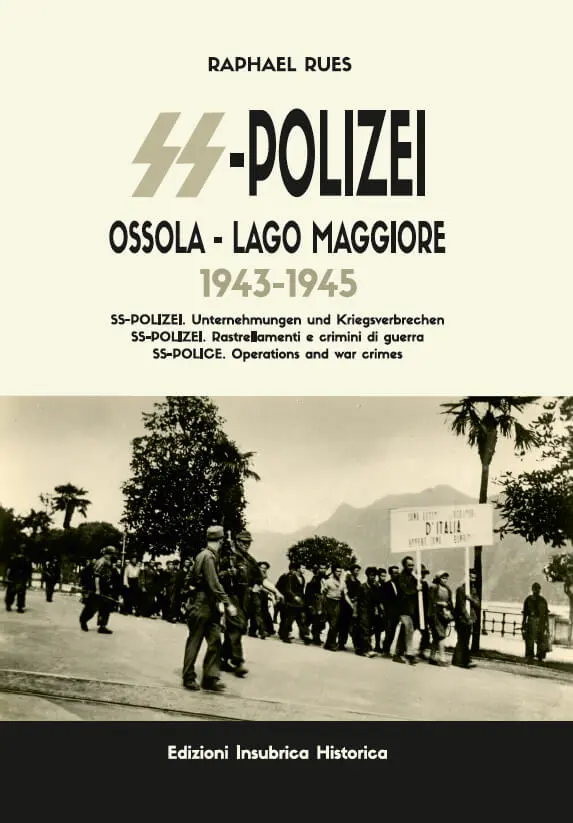
Confine di Sangue - I fatti dei Bagni di Craveggia 18-19 ottobre 1944
Edizione in italiano. Di Raphael Rues (Curatore e Autore). Vasco Gamboni, Alexander Grass, Nicola Guerini e Fiorenzo Rossinelli (Autori). CHF /EUR 15.00 Insubrica Historica, 2025.
ISBN: 978-88-3196-902-4 – Editore: Insubrica Historica Minusio
The combat missions took place predominantly in the dead of night. The military pilots, who helped the partisans, had Polish nationality. They usually departed from Brindisi, Southern Italy, heading towards the North. Their flying course was over the Adriatic Sea situated between Italy and the Balkans. Once, they reached Trieste, they turned west, taking 270-degrees flying cap, over the Italian Alps. As a matter of fact, this indirect path allowed them to avoid the German and Fascist anti-aircraft artillery. And at the end of September 1944, the Allied forces occupied the town of Pisa, so fighter squadrons began to operate with superior potential despite the limited autonomy of aeroplanes like Spitfires.
Anyway, to cut a long story short, the results of two bombardment days in September 1944 on Lake Maggiore will be seen in detail below. These days created an unprecedented panic wave among the civilian population, especially in Luino, Baveno and Intra-Verbania in Italy. The civilian population in Baveno and Intra was terrified in the days following the air strikes, being afraid of all aviation related activities.
Bombardment of Fondotoce on 25 September 1944 at 15:10 in the afternoon:
The fighter squadron composed of six Spitfire aeroplanes arrived from the South, across the lake, in Verbania-Fondotoce. Two aircraft bombed a house in Fondotoce. To date, it has been impossible to ascertain with confidence which house was hit.
Bombardment of Intra-Alta on 25 September 1944 at 15:10 in the afternoon:
Four aeroplanes attacked Fondotoce, bombing in this case a large civilian workers’ house called “il Cassinone” in the region of Intra-Alta. The bombardment of the house caused the death of 9 civilians (according to other sources 11 civilians were killed) and several civilians were wounded.
Air strike of Baveno and sinking of the boat “Genova” on 25 September 1944 at 15:30 in the afternoon:
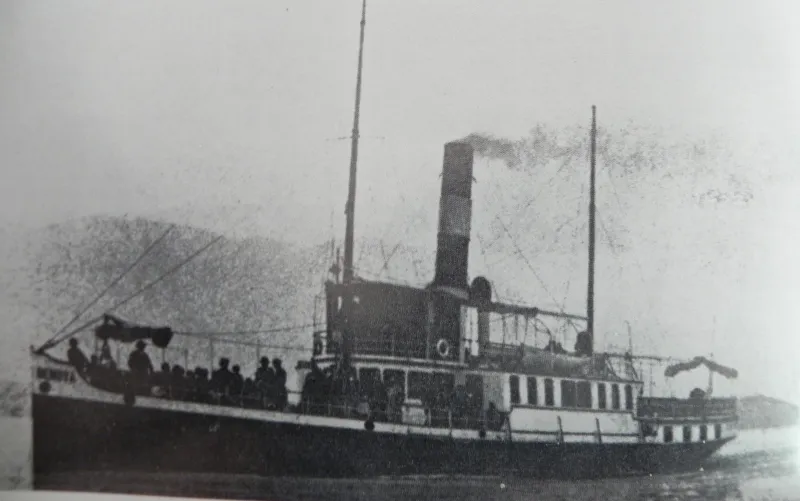
The locality of Baveno was attacked by six military aeroplanes. The air attack resulted in the sinking of the boat called “Genova” that carried apparently only civilians: 34 passengers were killed. The boat “Genova” was builded in 1912 by Bacigalupo, and it was 43.3 metres long. Like the similar ships “Milano” and “Torino”, it could transport 500 persons on board. The boat sank near the lakeshore. To date, it is unclear whether the wreck is still laying on the lake floor, or whether it was scrapped after the war. No official documents have been released concerning this matter.
Air attack of Luino and sinking of the boat “Torino” on 25 September 1944 at 16:00 in the afternoon:
The aerial intervention on Lake Maggiore on Monday, 25 September, culminated with the sinking of the second boat called “Torino” which went down in the port of Luino.
Air attack of Intra and sinking of the boat “Milano” on 26 September 1944 at 9:30 in the morning:
In the morning, on Tuesday, 26 September 1944, ignoring the previous air attacks, the battalion commander, Major Giovanni Ledo (1907 – n.a.), of the Fascist unit “Guardia Nazionale Repubblicana” (GNR) of the stormtroopers “Venezia Giulia”, decided to sail from Laveno to Intra-Verbania. He ordered that ammunition and other military goods be loaded on board the ship “Milano”. The boat carried also 40 soldiers and 30 civilians. Once the boat was in the middle of the lake sailing to its destination, it was attacked by fighter aircrafts. Officially 12 civilians and 14 soldiers were reported killed, but most likely, there was a greater number of victims. As a matter of fact, historians have been debating on the subject. Major Ledo survived but was heavily wounded and did not return to his post.
Air attack of Intra on 26 September 1944 at 10:00 in the morning:
Following the sinking of the third boat called “Milano”, the aircrafts persisted in their activity on the lakefront and at the port of Intra-Verbania, albeit without dreadful consequences.

Piroscafo Piemonte: 115 anni di storia sul Lago Maggiore
Avevamo già scritto in precedenza su alcuni aspetti storici della navigazione riguardante il Verbano (Link, 22.6.2018). Ciò che non avevamo illustrato è il fatto che la Navigazione Lago Maggiore detiene un primato,…
Even to date, there are blind spots concerning these events:
It is not clear which aircraft type was involved in the actions.
On 26 September 1944, later in the night, there were two spy missions (Mangosteen and Chrysler) in the regions of Mottarone-Coiromonte, only 5km away from Intra. It is likely that the bombardments created the premises for their successful launch.
The precise number of victims, particularly those on the boat “Milano”, is still unclear even after more than 80 years. The events related to the sunk boats “Genova” and “Milano” are still commemorated in Italy, albeit only by the organisations of the right political spectrum.
The newspapers of the Canton Ticino like “Popolo e Libertà” and “Libera Stampa” reported in 1944 that the aircrafts departed from the airfield of Domodossola and were directly involved with the partisan operations (eg. “Popolo e Libertà”, edition Friday 29 September 1944, article: “La Divisione Piave libera Cannobio”).
The boat “Milano” was finally found by a team of international divers, among them was a Dutch professional diver, Pim van der Horst .
The boat was located at a depth about 236 metres underwater. The highly complex immersion required a team composed of 40 divers and helicopter surveillance. It was authenticated by the South African Nuno Gomes (world depth record holder) and included in the “Guinness World Records”.
The wrecks of the boat “Torino” was found in 1945 as the ship had sunk in the shallow water. The engine was replaced, and the boat was transformed into a motor vessel; its superstructures were completely rebuilt. Some necessary refurbishments was done in 1969 that gave to the boat its current appearance, which made it look similar to the other 50-year-old motorboats, albeit with a slimmer hull. The vessel ist still today in use on Lake Maggiore.
Visits:
-
The boat Torino is still sailing today on Lake Maggiore. The victims of the sunken boats “Genova” and “Milano” are still officially remembered in Verbania-Pallanza. Every year, there is a ceremony that commemorates them.